DORA vs. SPACE Framework: Which Metrics Should Your Team Track?
June 2, 2026·9 min read·by Ihab Hamdy
When engineering leaders go looking for a way to measure productivity, they hit two acronyms: DORA and SPACE. They're often framed as rivals. They aren't — they answer different questions, and the strongest measurement programs use both.
What DORA measures
DORA (DevOps Research and Assessment) is built around four keys that measure software delivery performance:
Deployment Frequency — how often you ship
Lead Time for Changes — commit to production
Change Failure Rate — how often deploys break
Mean Time to Recovery — how fast you recover
DORA's strength is that all four are objective and system-derived. They come from your version control and deployment data — no surveys, no judgment calls. That makes them hard to argue with and easy to automate.
What SPACE measures
SPACE was proposed to capture what DORA deliberately leaves out: the human and multidimensional side of productivity. It's a framework with five dimensions, not a fixed set of metrics:
S — Satisfaction and well-being: how developers feel about their work and tools
P — Performance: outcomes of the work (quality, reliability)
A — Activity: counts of actions — commits, PRs, deploys
C — Communication and collaboration: how well work flows between people
E — Efficiency and flow: the ability to do work with minimal interruption
SPACE's core argument is that you should never measure a single dimension in isolation — activity without satisfaction, for instance, is how you get burnout dressed up as productivity.
DORA Metrics Calculator
Calculate your real DORA tier
Skip the spreadsheets — enter your four DORA dimensions and see your tier against the 2025 State of DevOps benchmarks in seconds.
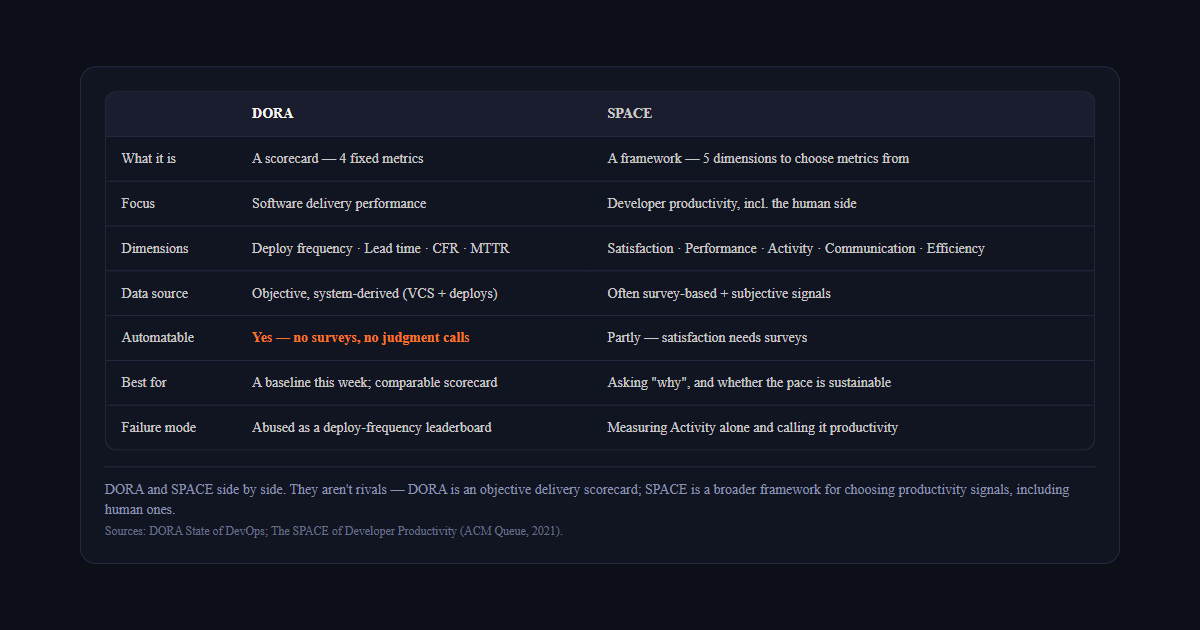
DORA is a scorecard. Four specific, objective metrics about delivery. Narrow, comparable, automatable.
SPACE is a framework. A set of dimensions to choose metrics from, including subjective ones like satisfaction. Broad, contextual, often survey-based.
DORA
SPACE
What it is
A scorecard — 4 fixed metrics
A framework — 5 dimensions to choose metrics from
Focus
Software delivery performance
Developer productivity, incl. the human side
Dimensions
Deploy frequency · Lead time · CFR · MTTR
Satisfaction · Performance · Activity · Communication · Efficiency
Data source
Objective, system-derived (VCS + deploys)
Often survey-based + subjective signals
Automatable
Yes — no surveys, no judgment calls
Partly — satisfaction needs surveys
Best for
A baseline this week; comparable scorecard
Asking "why", and whether the pace is sustainable
Failure mode
Abused as a deploy-frequency leaderboard
Measuring Activity alone and calling it productivity
DORA and SPACE side by side. They aren't rivals — DORA is an objective delivery scorecard; SPACE is a broader framework for choosing productivity signals, including human ones.Sources: DORA State of DevOps; The SPACE of Developer Productivity (ACM Queue, 2021).
DORA tells you how your delivery pipeline is performing. SPACE tells you whether that performance is sustainable for the humans producing it. They overlap — DORA's metrics map neatly into SPACE's Performance and Efficiency dimensions — but neither replaces the other.
When to use which
Start with DORA if you have nothing. It's objective, automatable, and gives you a baseline this week. It's also what most engineering orgs and benchmarks speak in.
Add SPACE dimensions once DORA is stable and you start asking "why" questions — why is lead time creeping up, is the team overloaded, is collaboration breaking down. That's where satisfaction and collaboration signals earn their place.
Use both together at maturity. DORA for the objective delivery scorecard; selected SPACE signals to keep it honest about sustainability.
A related but separate question is DORA vs. flow metrics — flow metrics (PR cycle time, work-in-progress, throughput) sit underneath DORA and explain why a delivery number is moving. For that comparison specifically, see our guide to engineering metrics, which lays out the DORA scorecard alongside the day-to-day flow metrics.
A common failure mode
The worst thing you can do with either framework is reduce it to a single number and rank engineers by it. SPACE was written partly as a reaction against exactly that — measuring Activity (commit counts, lines of code) alone and calling it productivity. DORA resists this better because its metrics are team-level and outcome-based, but it can still be abused if you treat deployment frequency as a leaderboard. Measure teams and systems, not individuals.
How Deviera fits
Deviera is an engineering intelligence platform that computes the DORA scorecard automatically from your existing GitHub and Vercel events — Deployment Frequency, Lead Time, CFR, and MTTR, benchmarked against the 2025 State of DevOps — plus flow signals like PR cycle time that map to SPACE's Efficiency dimension. It gives you the objective half of the picture without instrumentation, leaving you free to layer in the human signals SPACE calls for.
DORA is a set of four objective, system-derived delivery metrics — Deployment Frequency, Lead Time for Changes, Change Failure Rate, and Mean Time to Recovery — pulled from your version control and deployment data with no surveys. SPACE is a broader framework with five dimensions for choosing productivity signals: Satisfaction and well-being, Performance, Activity, Communication and collaboration, and Efficiency and flow. DORA measures how your delivery pipeline performs; SPACE captures the human, multidimensional side DORA deliberately leaves out.
What is the difference between DORA and SPACE?
The cleanest way to hold them apart: DORA is a scorecard and SPACE is a framework. DORA is four specific, objective metrics about delivery — narrow, comparable, and automatable. SPACE is a set of dimensions to choose metrics from, including subjective ones like satisfaction — broad, contextual, and often survey-based. They overlap (DORA's metrics map into SPACE's Performance and Efficiency dimensions) but neither replaces the other.
Should I use both DORA and SPACE?
Yes, at maturity. Start with DORA if you have nothing — it's objective, automatable, and gives you a baseline this week, and it's the language most engineering orgs and benchmarks speak in. Add SPACE dimensions once DORA is stable and you start asking 'why' questions (why lead time is creeping up, whether the team is overloaded, whether collaboration is breaking down). Use both together at maturity: DORA for the objective delivery scorecard, selected SPACE signals to keep it honest about sustainability.
Is SPACE replacing DORA?
No. They aren't rivals and neither replaces the other — they answer different questions. DORA tells you how your delivery pipeline is performing; SPACE tells you whether that performance is sustainable for the humans producing it. The strongest measurement programs use both.