DORA MetricsEngineering StrategyEngineering Metrics
How to Improve Your DORA Metrics: A 4-Week Roadmap
June 2, 2026·9 min read·by Ihab Hamdy
Most engineering leaders can recite the four DORA metrics but have no concrete plan to improve them. "Get better at deployment frequency" is not a plan. This is — a week-by-week roadmap that takes a team from "we don't really measure this" to measurable movement on all four keys in a month.
Before you start: the four keys, briefly
The four DORA metrics split into two pairs. Throughput: lead time for changes and deployment frequency. Stability: change failure rate and MTTR. The research is clear that elite teams score well on both pairs at once — speed and stability are not a trade-off. This roadmap is built to move both.
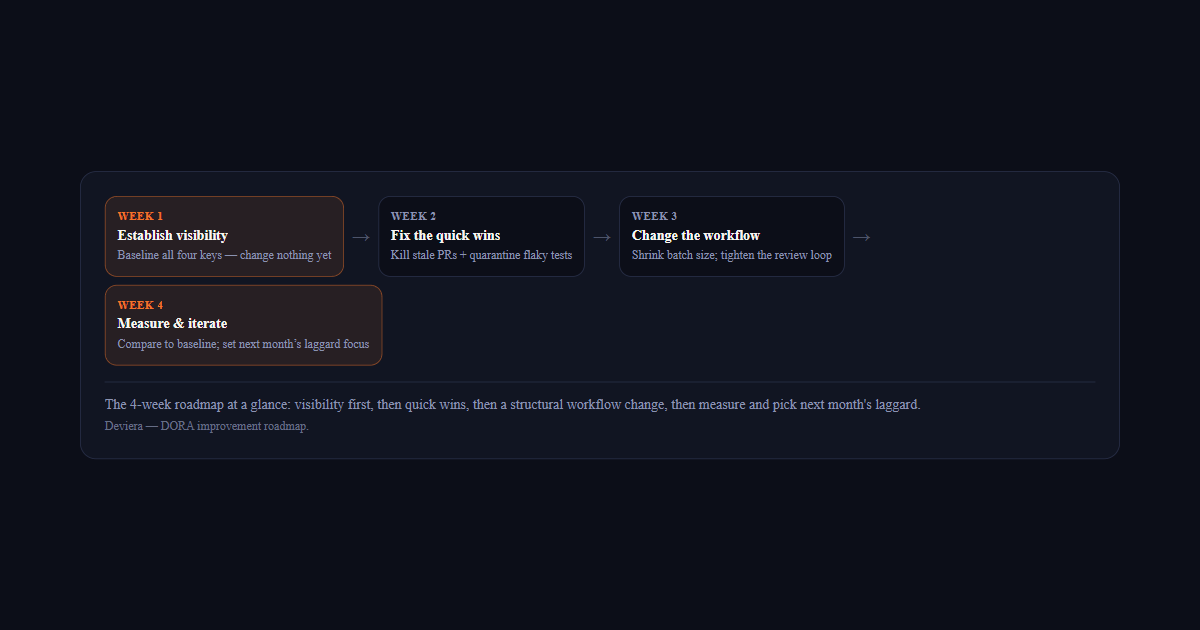
Week 1Establish visibilityBaseline all four keys — change nothing yet
→
Week 2Fix the quick winsKill stale PRs + quarantine flaky tests
→
Week 3Change the workflowShrink batch size; tighten the review loop
→
Week 4Measure & iterateCompare to baseline; set next month’s laggard focus
The 4-week roadmap at a glance: visibility first, then quick wins, then a structural workflow change, then measure and pick next month's laggard.Deviera — DORA improvement roadmap.
DORA Metrics Calculator
Set your baseline before week 1
You can't improve what you haven't measured. Enter your four DORA dimensions to see your starting tier against the 2025 State of DevOps benchmarks.
You cannot improve what you cannot see, and you cannot prove improvement without a baseline. Week 1 is entirely about measurement. Change nothing yet.
Capture your current numbers for all four keys. If you have no tooling, the free DORA calculator gives you a one-time read; Deviera computes them continuously from your GitHub and Vercel events so the baseline keeps updating. Either way, write down where you stand today against the tiers:
Deployment frequency: Elite is on-demand; Low is monthly or less.
Lead time: Elite is under a day; Low is over a month.
Change failure rate: Elite is under 5%; Low is over 15%.
MTTR: Elite is under an hour; Low is over a week.
Most teams discover at least one metric is far worse than they assumed. That surprise is the point — it tells you where Week 2 and 3 should aim.
Week 2 — Fix the quick wins
Two problems give the best return for the least effort, because they silently inflate multiple metrics at once: stale PRs and flaky tests.
Kill stale PRs
A stale PR inflates lead time directly — work that's finished but unmerged isn't shipped. The fix is not "tell people to review faster"; it's making staleness visible the moment it happens. Set a threshold (48 hours is a good start), and have something nudge the reviewers automatically when a PR crosses it. Track PR cycle time so you can see the pickup-to-review gap shrink.
Quarantine flaky tests
A flaky test hurts you twice: it forces pipeline re-runs (inflating lead time) and it trains the team to ignore red builds (inflating change failure rate, because real failures get waved through). Detect the alternating pass/fail pattern, file the flaky test as a tracked bug, and quarantine it so it stops blocking deploys while it's being fixed.
Neither of these requires a process overhaul. They require detection — which is exactly what an automation layer provides without adding human overhead.
Week 3 — Change the workflow
Weeks 1 and 2 were about seeing and cleaning up. Week 3 is the structural change that moves the needle for good: shrink your batch size.
Deploy smaller, more often
Batch deploys are the root cause of bad throughput and bad stability. A weekly release means a change finished on Monday waits days to ship (bad lead time), and when the big batch breaks, you can't tell which of forty changes did it (bad MTTR, bad CFR). Moving toward continuous, smaller deploys improves all four metrics simultaneously. Aim to at least double your deployment frequency this week.
Tighten the review loop
Pair the smaller batches with a faster review loop: automated checks running before a human reviews, clear reviewer assignment via CODEOWNERS, and a first-review SLA. The goal is to keep the pickup phase of PR cycle time near zero so small changes don't sit waiting.
Week 4 — Measure and iterate
Return to your Week 1 baseline and compare. You should see movement — lead time down, deployment frequency up, fewer flaky-driven failures. Now do the honest part: find the metric that moved least.
If MTTR is still poor, your detection gap is the problem — see how to reduce MTTR.
If change failure rate is still high, your testing and rollback story needs work.
If lead time barely moved, the bottleneck is deeper in the pipeline than review — manual release steps, environment provisioning, or approval gates.
Set that laggard as next month's focus, and repeat the cycle. DORA improvement is not a one-time project; it's a monthly loop of measure → fix → measure.
Why automation does the heavy lifting
Notice what every step above has in common: it depends on noticing something the instant it happens — a PR going stale, a test flaking, a deploy failing — and acting on it without adding a human to the loop. That's precisely what an engineering intelligence platform automates. Deviera tracks all four DORA metrics continuously, nudges stale PRs, files flaky-test bugs, and opens-then-auto-resolves incidents so your MTTR clock is measured rather than guessed. The roadmap is the strategy; automation is what makes it stick without burning your team's attention.
For the full landscape of metrics this roadmap touches — and how they relate — see our guide to engineering metrics. And if you're weighing DORA against other frameworks, read DORA vs. SPACE.
Frequently asked questions
How long does it take to improve DORA metrics?
Four weeks is enough to move lead time and change failure rate meaningfully, because both respond to process changes like smaller batches and faster review. Deployment frequency often follows within the same window. MTTR is the slowest of the four, since it depends on detection and rollback tooling that usually needs building rather than agreeing. Expect the first fortnight to produce a baseline and the second to produce visible movement.
Which DORA metric should you improve first?
Lead time for changes, in almost every case. It is the metric most directly under the team's control, it responds fastest to process changes, and improving it tends to drag the other three with it — smaller batches shipped sooner mean less risk per deploy, which lowers change failure rate and makes recovery simpler. Starting with deployment frequency instead often produces the frequency trap: shipping more often without the review and testing discipline to keep it safe.
Can you improve DORA metrics without changing team size?
Yes, and headcount is rarely the constraint. The dominant costs in most teams are waiting and rework — pull requests queueing for review, flaky tests forcing re-runs, and deploys failing for reasons nobody tracked. None of those are fixed by adding people, and adding people to a team with review-capacity problems usually makes the queue longer before it makes it shorter.
What is a realistic DORA improvement in one quarter?
Moving one tier on two of the four keys is a strong quarter. Teams starting from a low baseline often see faster movement than that because the early wins are large — killing stale PRs and quarantining flaky tests can halve lead time on their own. Teams already at high performance find elite considerably harder, since the remaining constraints are architectural rather than procedural.