7 Best Jellyfish Alternatives & Competitors (2026)
May 25, 2026·9 min read·by Ihab Hamdy
Jellyfish is built for executives who need engineering-investment and headcount reports — and it's priced for them, at $12,000+/year with a 50-seat minimum. If that doesn't match your team or budget, the good news is the engineering intelligence market is crowded with strong alternatives. Here are the seven best Jellyfish alternatives in 2026, what each does well, and which one fits your use case.
Why teams look for a Jellyfish alternative
Jellyfish does one job very well: connecting engineering effort to business initiatives so VPs of Engineering and CTOs can plan headcount and report contribution to the board. The complaints that send teams looking for alternatives are consistent: the ~$12,000/year price with a 50-seat minimum prices out small and mid-size teams; the product is built for leadership reporting rather than the engineers doing the work; and it tells you what happened last quarter rather than acting on what's breaking right now.
Depending on which of those is your dealbreaker, a different alternative wins. We've grouped them by the job they're actually best at.
Recommended for you
Try a self-serve alternative free
No sales call, no minimum seats. Connect GitHub to Deviera and see engineering signals turn into action — automations, friction scores, DORA — in minutes.
1. Deviera — best for real-time automation and small-to-mid teams
Deviera takes the opposite approach to Jellyfish: instead of reporting on engineering investment after the fact, it detects friction as it happens and acts on it. When CI fails on main, a PR sits in review for 48 hours, or a deployment fails, Deviera creates a structured ticket in Linear, Jira, or ClickUp automatically — with repo, branch, and failure context pre-filled — and auto-resolves it when the underlying problem clears.
Best for: Teams of 1–50 engineers who want friction detection and ticket automation without an enterprise procurement process.
Strengths: Trigger → action automation engine, live DORA metrics from real GitHub and Vercel events, CI/flaky-test detection, a composite Friction Score, and full GitLab support.
Pricing: Free tier (1 repo, 5 automations, no credit card); Pro at $29/month with no seat minimum.
Trade-off: Lighter on board-level investment-allocation reporting than Jellyfish — by design.
2. LinearB — best for measuring AI impact alongside DORA delivery
LinearB is one of the most established engineering intelligence platforms, and in 2026 it positions itself as "the AI productivity platform for engineering leaders" — its tagline is "AI has changed how code is generated. LinearB helps you get it shipped." Alongside its long-standing strengths in Git analytics (cycle time, PR throughput, review depth) and policy-based PR automation, it now leads with measuring how AI coding tools affect delivery speed and quality. It's a 2026 Gartner Magic Quadrant Leader for developer productivity platforms.
Best for: Engineering leaders who want to quantify AI-tool ROI plus DORA reporting and workflow automation.
Trade-off: Turning a detected pattern into a structured ticket in your issue tracker still requires meaningful manual rule configuration. See our full Deviera vs LinearB comparison.
3. Swarmia — best for combining developer experience with delivery and business outcomes
Swarmia positions itself in 2026 as "engineering intelligence you can trust," with a message built around scaling velocity across the whole delivery pipeline rather than just accelerating individual engineers. It pairs its long-standing strengths — developer-experience surveys, flow, and healthy working patterns — with DORA metrics, AI adoption and cost measurement, investment-balance reporting, and audit-ready software capitalization. It emphasizes actionable intelligence over vanity metrics.
Best for: Teams that want developer experience and flow plus delivery metrics and business-outcome reporting in one place.
Trade-off: Lighter on real-time CI/CD intelligence and proactive ticket automation than tools built around operational signal detection. See Deviera vs Swarmia.
4. Faros AI — best for large enterprises measuring AI coding at scale
Faros AI bills itself as a software engineering intelligence platform for enterprises, and in 2026 its messaging centers on making AI coding work — "visibility into how engineering operates and control over how work progresses, across teams, tools, and AI agents." It unifies many data sources into a customizable model, with DORA metrics, cycle-time tracking, delivery forecasting, causal ROI analysis, and enterprise-grade security (SOC 2 Type II, ISO 27001). It's aimed squarely at the same large-org buyer as Jellyfish.
Best for: Large enterprises (hundreds to thousands of engineers) that need a customizable engineering-operations data layer and rigorous AI-impact measurement.
Trade-off: Enterprise-oriented setup and pricing; heavier to adopt than self-serve tools.
5. Allstacks — best for agentic delivery forecasting and risk detection
Allstacks now describes itself as "the agentic platform for software engineering and product management," using AI agents to grade specifications before development begins, detect delivery risks 3–4 weeks early, and generate audit-ready software cost-capitalization reports from engineering activity. It overlaps with Jellyfish on connecting engineering work to business outcomes, with a stronger emphasis on predictive, forward-looking signals.
Best for: Leaders who want forward-looking delivery-risk forecasting and spec-quality checks, not just historical metrics.
Trade-off: Forecasting and capitalization value depend on disciplined project-tracker hygiene; less focused on day-to-day CI/PR automation.
6. DX — best for research-backed developer productivity and AI measurement
DX positions itself in 2026 as "developer intelligence for the AI era." Designed by the researchers behind the DevEx and SPACE frameworks, it combines quantitative delivery metrics (via its DX Core 4 and TrueThroughput frameworks) with qualitative developer-experience surveys, plus dedicated GenAI adoption tracking and ROI measurement. With customers like Dropbox, Vanguard, and Booking.com, it's a strong fit for large orgs that want rigorous, research-grounded measurement of productivity and AI impact.
Best for: Larger orgs that want survey-based DevEx measurement and AI-adoption ROI alongside delivery metrics.
Trade-off: Measurement-and-insight focused; it is not a real-time automation/action layer.
7. Jellyfish itself — when it's still the right call
Jellyfish now markets itself as "the intelligence platform for AI-integrated engineering," adding AI-impact tracking and DevFinOps (automated R&D capitalization and tax-credit reporting) on top of its core engineering-allocation engine. But that core is still the reason to buy it: if your primary need is executive investment allocation — connecting project data to engineering output via its patented unified data model, headcount planning across many teams, and board-facing R&D spend reports — Jellyfish remains purpose-built for exactly that, and the price reflects that enterprise buyer. The question isn't whether Jellyfish is good; it's whether that job is the one you're trying to do.
How the alternatives compare at a glance
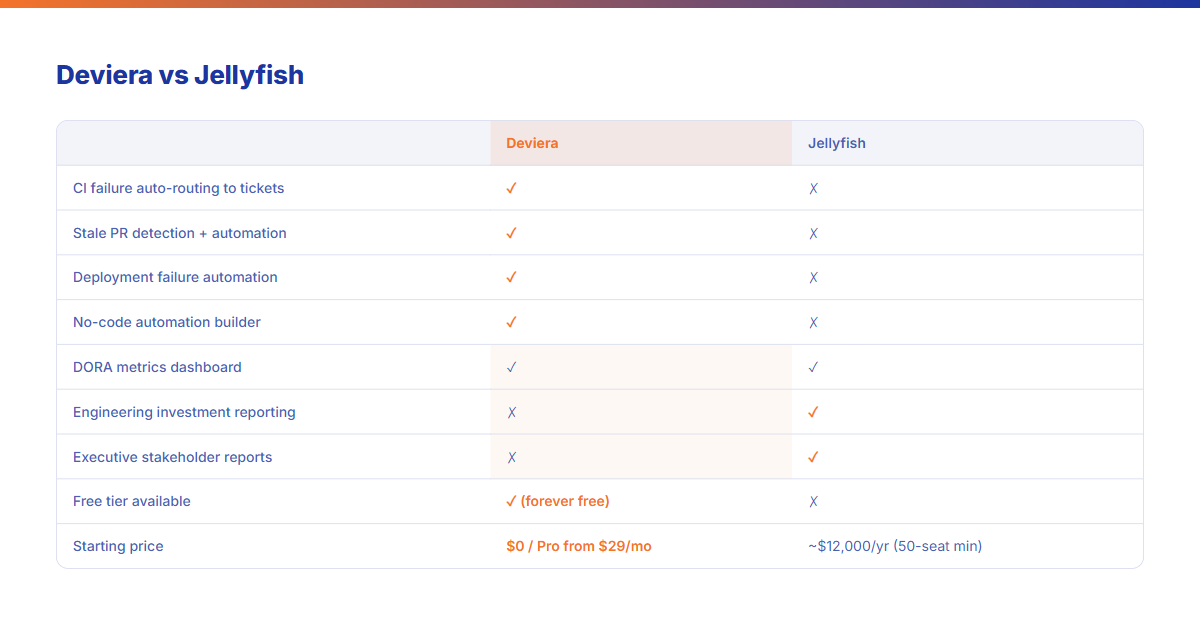
The category splits cleanly into two layers. Analytics-and-reporting tools (Jellyfish, LinearB, Swarmia, Faros, Allstacks, DX) measure engineering output — retrospectively or predictively — for leaders. Action tools like Deviera detect friction in real time and route it as tickets, nudges, and auto-resolutions for the engineers doing the work. Most mature orgs eventually run one of each.
Deviera
Jellyfish
CI failure auto-routing to tickets
✓
✗
Stale PR detection + automation
✓
✗
Deployment failure automation
✓
✗
No-code automation builder
✓
✗
DORA metrics dashboard
✓
✓
Engineering investment reporting
✗
✓
Executive stakeholder reports
✗
✓
Free tier available
✓ (forever free)
✗
Starting price
$0 / Pro from $29/mo
~$12,000/yr (50-seat min)
Deviera and Jellyfish barely overlap. Deviera automates day-to-day engineering friction (CI, PRs, deploys) from a free tier; Jellyfish is executive investment reporting at enterprise pricing. The right choice is whichever job is actually yours.Deviera vs Jellyfish — feature comparison (deviera.dev/vs/jellyfish).
Pricing comparison
Pricing is where these tools diverge most sharply, and it's the most common reason teams leave Jellyfish:
Jellyfish: Contact sales. Based on published reports and customer feedback, pricing starts at approximately $12,000/year with a minimum of 50 seats — an enterprise procurement model.
Deviera: Free plan (5 automations, 1 repo, no credit card). Pro at $29/month for individuals and small teams. Team plan at $25/seat/month (minimum 5 seats) for full CI automation, GitLab, Slack, and DORA metrics. 14-day Pro trial on every account.
LinearB, Swarmia, DX: Per-seat, typically sales-assisted; positioned above Deviera but below Jellyfish's seat minimum.
Faros AI, Allstacks: Enterprise pricing, contact sales — aimed at the same large-org buyer as Jellyfish.
Choose Deviera if you want CI failures, stale PRs, and deployment issues routed as tickets automatically — with a free tier, no seat minimum, and live DORA metrics from your real events.
Choose LinearB if you want AI-impact measurement plus DORA reporting and workflow automation, and don't mind configuring rules.
Choose Swarmia if you want developer experience and flow combined with delivery and business-outcome metrics.
Choose Faros AI or Allstacks if you're a large org that needs enterprise-grade AI-coding measurement, engineering-operations, or agentic delivery-forecasting analytics.
Choose DX if you want research-backed measurement of developer productivity and AI adoption.
Stay on Jellyfish if board-level engineering-investment and headcount reporting is genuinely your main job.
The bottom line
Most teams searching for a Jellyfish alternative aren't unhappy with Jellyfish's quality — they're paying enterprise analytics prices for a job they don't have. If you need real-time friction detection and automation rather than executive investment reporting, Deviera is the most accessible place to start: a free tier, no seat minimum, and your first automation running within minutes.
For the detailed feature-by-feature breakdown, see the
Deviera vs Jellyfish
comparison, or start the free trial directly — no credit card required.
Frequently asked questions
What are the best Jellyfish alternatives in 2026?
The best Jellyfish alternatives in 2026 are Deviera (real-time CI/PR/deploy automation, free tier), LinearB (AI productivity measurement plus DORA and workflow automation), Swarmia (developer experience combined with delivery and business-outcome metrics), Faros AI (enterprise AI-coding measurement and engineering operations), Allstacks (agentic delivery forecasting and risk detection), and DX (research-backed developer productivity and AI measurement). The right choice depends on whether you need to act on engineering friction in real time or report on engineering investment and AI impact to executives.
Is there a free Jellyfish alternative?
Yes. Deviera offers a genuinely free tier (1 repo, 5 automations, no credit card) that detects CI failures and stale PRs and routes them as tickets automatically. Most other engineering intelligence platforms — including Jellyfish, LinearB, and Faros AI — are paid-only or require a sales call, though several offer free trials. Deviera is the most accessible starting point for small teams that want to evaluate before paying.
How much does Jellyfish cost compared to its alternatives?
Jellyfish pricing is not public; based on published reports it starts at roughly $12,000/year with a 50-seat minimum — an enterprise procurement model. By contrast, Deviera starts at $0 (free tier) with Pro at $29/month and no seat minimum. LinearB, Swarmia, and DX sit between the two, typically per-seat with a sales-assisted process. The widest gap is at the small-team end, where Jellyfish's seat minimum prices most teams out entirely.
What is the main difference between Jellyfish and Deviera?
Jellyfish is an executive analytics platform — it aggregates Git and project-tracking data into engineering investment, headcount, and allocation reports for leaders. Deviera is an engineering automation platform — it detects CI failures, stale PRs, and deployment issues in real time and routes them as structured tickets to Linear, Jira, or ClickUp automatically. Jellyfish measures what happened; Deviera acts on what is happening now.
Jellyfish vs Allstacks — which is better for engineering VPs?
Both connect engineering work to business outcomes for leaders, but they emphasize different time horizons. Jellyfish is strongest at retrospective executive reporting — engineering investment, headcount, and allocation against business initiatives. Allstacks leans forward-looking and agentic: it grades specifications before development, flags delivery risks 3–4 weeks early, and generates audit-ready cost-capitalization reports from engineering activity. Choose Jellyfish if your priority is board-level investment-allocation reporting; choose Allstacks if you want predictive delivery-risk forecasting and spec-quality checks. Both depend on disciplined project-tracker hygiene and are less focused on day-to-day CI/PR automation.
Does Jellyfish integrate with Jira and GitHub to map engineering work to business initiatives?
Yes. Jellyfish's core job is connecting engineering effort to business initiatives by aggregating Git and project-tracking data, so VPs of Engineering and CTOs can plan headcount and report contribution to the board. That executive, after-the-fact reporting is what it does well. The trade-off is that it reports what happened last quarter rather than acting on what's breaking now, and its ~$12,000/year price with a 50-seat minimum prices out small and mid-size teams — which is why teams that want real-time CI/PR/deploy automation rather than leadership reporting look at action-layer tools instead.