Getting budget approved for engineering tools is harder than building the tools themselves.
CFOs want numbers, not stories. This guide gives you a framework to calculate the real cost
of engineering friction — and present a budget case that gets approved.
The budget conversation you're losing
You've been there. You walk into a budget meeting with a compelling case: "Our CI pipeline is
broken, our PR review times are through the roof, and we need tooling to fix it." The CFO
nods politely and asks: "What's the cost of not fixing it?"
You stumble. You say something about "engineering happiness" or "developer experience."
The CFO smiles and says let's table this. Six months later, your team is still losing
5 hours per week to manual triage, and you've lost two senior engineers who didn't want
to wait anymore.
The problem isn't that your case is wrong. It's that you're speaking a different language.
CFOs speak the language of numbers, risk, and opportunity cost. You need to meet them there.
Step 1: Measure the hidden cost of friction
Before you can build a budget case, you need data. The average engineering team loses
4-7 hours per week per engineer to recoverable overhead:
CI triage — investigating failures, re-running tests, chasing down flaky tests
Manual routing — copying GitHub issues to Jira, updating status across tools
Deployment debugging — investigating failed deploys, rolling back, diagnosing
Dashboard switching — checking GitHub, CI, Jira, Slack, Vercel, and monitoring separately to understand a single incident
That last item is frequently overlooked. Research on attention residue shows that each
context switch between tools costs ~23 seconds of re-orientation time. Engineers switch
between dashboards ~40 times per day — that's 15+ minutes of pure switching
overhead daily, or 60+ hours per engineer per year, before a single problem
is addressed. For a 10-person team: 600+ hours/year. At $90/hour loaded cost,
that's $54,000/year lost to tab management alone — a line item most
budget proposals never include.
Here's a quick audit you can run with your team: ask each engineer to track
"non-coding time" for one week. Use a simple spreadsheet with three columns:
activity, duration, and was it preventable? Most teams are shocked by the total.
Recommended for you
Quantify the friction you're paying for
Deviera scores the hidden cost of friction from your real engineering signals — the number your budget request needs, without a manual audit.
Once you have hours lost per week, converting to dollars is straightforward:
Take your team's fully loaded cost (salary + benefits + overhead)
Divide by ~2000 working hours per year to get hourly cost
Multiply by hours lost per week × 52 weeks
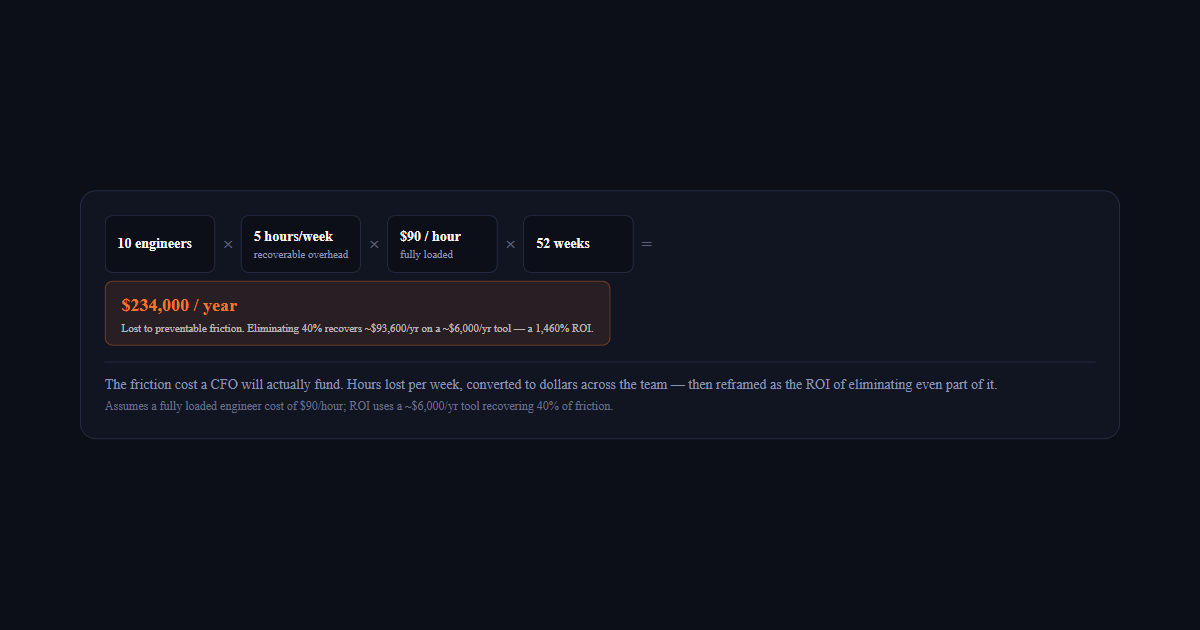
For a 10-person team at $90/hour loaded cost, losing 5 hours per week per engineer
translates to $234,000 per year in lost productivity. That's not a
tooling budget request — that's a profit and loss conversation.
10 engineers
×
5 hours/weekrecoverable overhead
×
$90 / hourfully loaded
×
52 weeks
=
$234,000 / yearLost to preventable friction. Eliminating 40% recovers ~$93,600/yr on a ~$6,000/yr tool — a 1,460% ROI.
The friction cost a CFO will actually fund. Hours lost per week, converted to dollars across the team — then reframed as the ROI of eliminating even part of it.Assumes a fully loaded engineer cost of $90/hour; ROI uses a ~$6,000/yr tool recovering 40% of friction.
Step 3: Frame the investment, not the cost
Here's the mental shift that changes the conversation: you're not asking for a budget
increase. You're proposing an investment with a quantifiable return.
The average engineering intelligence tool costs $500/month for a 10-person team.
If it eliminates even 40% of the friction you measured above, you're looking at:
Investment: $6,000/year
Return: $93,600 in recovered engineering time
ROI: 1,460%
Put that in a spreadsheet and watch the CFO's posture change.
How do you measure ROI from development forecasting tools?
Measure the hours the tool removes, price them at fully loaded cost, and compare against the subscription. Capture a baseline for two or three specific numbers — CI triage hours, PR cycle time, incidents per month — for at least a fortnight before you buy, then report the identical numbers afterwards. Changing metric midway is what makes finance discount the whole claim.
Step 4: Build the budget request document
Structure your proposal like this:
Executive summary: One sentence. "We lose $X/year to preventable engineering friction; this tool recovers $Y for $Z/year."
The data: Hours lost per week, converted to dollars. Include a table.
The alternative: What happens if you do nothing? Include attrition risk.
The investment: Tool cost, implementation time, training cost.
The return: Conservative estimate (e.g., "we expect to recover 30-50%").
Approval timeline: "If approved by May 1, we can start seeing returns by Q3."
What CFOs actually care about
After you've built your case, remember these three things CFOs always look for:
Quantified risk: Show them what could go wrong if you don't act (attrition, missed deadlines, quality issues)
Reversibility: If this doesn't work, can you cancel? Annual contracts with 30-day notice are safer bets.
Benchmark comparison: "Company X used this exact approach and saw Y% improvement" carries weight.
The conversation starter
Next time you're in a budget meeting, don't lead with "we need better tooling."
Lead with: "I've done a cost analysis on our engineering friction, and I have
a proposal that pays for itself in 6 weeks."
That's the conversation that gets you to yes. Deviera's
Value Dashboard
tracks hours saved, automations fired, and issues auto-created in real time —
giving you live ROI data to back the budget case, not just a one-time estimate.
For the friction baseline, the free
CI Health Score Calculator
gives you a scored starting point in under 2 minutes.
Frequently asked questions
How do you measure ROI from engineering tools for budget justification?
Quantify the friction first, then frame the tool as an investment with a return. Step 1: measure recoverable overhead — the average engineering team loses 4–7 hours per week per engineer to CI triage, PR coordination, manual routing, deployment debugging, and dashboard switching. Step 2: convert to dollars — take fully loaded cost (salary + benefits + overhead), divide by ~2,000 working hours/year for an hourly rate, then multiply by hours lost per week × 52. For a 10-person team at $90/hour losing 5 hours/week each, that's $234,000/year in lost productivity. Step 3: frame it as an investment — a ~$500/month ($6,000/year) tool that eliminates even 40% of that friction recovers ~$93,600 in engineering time, a 1,460% ROI. Put that in a spreadsheet rather than leading with 'developer experience,' because CFOs fund quantified risk and opportunity cost, not vague velocity claims.
How do you justify an engineering tooling budget to a CFO?
Lead with the cost of inaction, not the tool. Structure the proposal as: an executive summary ('we lose $X/year to preventable friction; this tool recovers $Y for $Z/year'), the data as a table of hours lost converted to dollars, the alternative (what doing nothing costs, including attrition risk), the investment (tool cost, implementation, training), the return (a conservative 30–50% recovery estimate), and an approval timeline. CFOs specifically look for quantified risk, reversibility (annual contracts with 30-day notice are safer bets), and benchmark comparisons — so include all three.
What if finance asks you to prove the savings after the purchase?
Expect the question and instrument for it before you buy, because a baseline captured after the tool is in place is not a baseline. Record the two or three numbers your business case rests on — hours spent on CI triage, PR cycle time, incidents per month — for at least a fortnight beforehand. Then report the same numbers on the same cadence afterwards. The credibility comes from measuring the identical thing both times; switching metrics midway is what makes finance teams discount the whole claim, even when the tool genuinely worked.
Should you build the tooling internally instead of buying it?
Price the build honestly and it usually loses. The visible cost is the initial implementation, which is often genuinely small — a few days of scripting. The cost that sinks internal tooling is maintenance: webhook payloads change, an API deprecates, the person who wrote it moves teams, and the tool quietly stops working at the exact moment nobody is watching. Multiply an engineer's loaded hourly cost by a realistic ongoing maintenance estimate and compare that with the subscription. Build when the workflow is genuinely specific to your organisation; buy when it is a problem thousands of teams share.